

Gabriel mesta, p.1
Gabriel Mesta, page 1
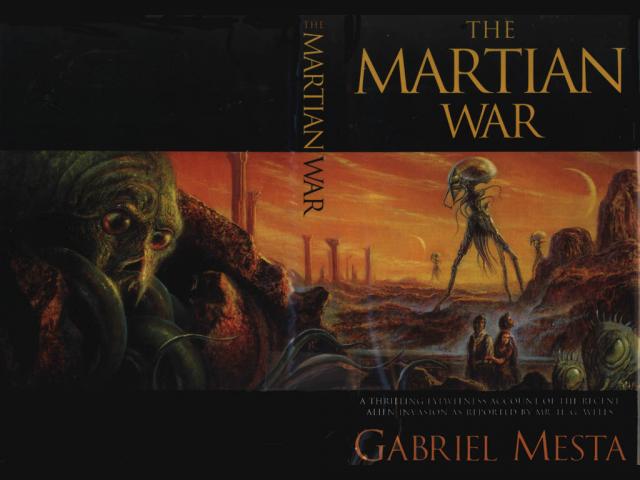


THE
MARTIAN WAR
A THRILLING EYEWITNESS ACCOUNT
OF THE RECENT ALIEN INVASION AS
REPORTED BY MR. H. G. WELLS
GABRIEL MESTA
Pocket Books
NEW YORK LONDON TORONTO SYDNEY
POCKET BOOKS, a division of Simon & Schuster, Inc, 1230 Avenue of the Americas, New York, NY 10020
This book is a work of fiction. Names, characters, places and incidents are products of the author’s imagination or are used fictitiously. Any resemblance to actual events or locales or persons living or dead is entirely coincidental.
Copyright © 2005 by WordFire, Inc.
Cover art and interior sketches by Bob Eggleton
All rights reserved, including the right to reproduce this book or portions thereof in any form whatsoever. For information address Pocket Books, 1230 Avenue of the Americas, New York, NY 10020
Library of Congress Cataloging-in-Publication Data
Mesta, Gabriel.
The martian war : a thrilling eyewitness account of the recent alien invasion as reported by Mr. H. G. Wells / Gabriel Mesta.—1st Pocket Books hardcover ed.
p. cm.
ISBN 0-7434-4639-9 (hardcover) 1. Wells, H. G. (Herbert George), 1866-1946—Fiction. 2. Human-alien encounters—Fiction. 3. Space warfare—Fiction. 4. Mars (Planet)—Fiction. 5. Novelists—Fiction. I. Title. PS3613.E876M37 2005 813’.6—dc22
2004042399
First Pocket Books hardcover edition May 2005 10 987654321
POCKET and colophon are registered trademarks of Simon & Schuster, Inc.
Manufactured in the United States of America
For information regarding special discounts for bulk purchases, please contact Simon & Schuster Special Sales at 1-800-456-6798 or business@simonandschuster.com.
Portions of the first two chapters have been previously published as “Scientific Romance” by Kevin J. Anderson in The UFO Files, edited by Ed Gorman & Martin H. Greenberg, DAW, 1998; and “Canals in the Sand” by Kevin J. Anderson in War of the Worlds: Global Dispatches, edited by Kevin J. Anderson, Bantam, 1996.
To the imagination, genius, and sheer
enthusiasm of MR. HARLAN ELLISON,
who has raised the bar for all of us
ACKNOWLEDGMENTS
This book—and indeed a large portion of the science fiction genre—would not exist without the groundwork laid by H. G. Wells and Percival Lowell. Wells single-handedly introduced the world to many of science fiction’s best-loved concepts. Despite repeated censure and ridicule from his peers, Lowell’s tireless promotion of Mars as the abode of life kindled a public fascination with Martians and their dying world.
Most especially, I must express my gratitude to the estate of H. G. Wells for allowing me to do this book. I would also like to thank the staff at the Lowell Observatory in Flagstaff, Arizona, for their help and suggestions.
I give a respectful nod to Stephen Baxter for putting me in touch with the heirs of H. G. Wells; my editor John Ordover at Pocket Books for “getting it” in the first place, and then Jennifer Heddle for taking over the project; Bob Eggleton for his marvelous autopsy sketches and his enthusiasm for the story; Cherie Buchheim (“Research Babe”) for her fact-checking skills; John Teehan, Robyn Herrington, and Mark Bourne for helping me track down some of Wells’s more obscure writings; Catherine Sidor, Diane Jones, and Louis Moesta for their assistance in various stages of preparing this manuscript; and, of course, Rebecca Moesta Anderson for most everything else.
CONTENTS
PROLOGUE: CELESTIAL MECHANICS
1. Mr. Wells and Professor Huxley Observe the Leonids 3
2. Percival Lowell and Dr. Moreau Send a Message to Mars 13
PART I: SCIENTIFIC ROMANCE
3. A Message from an Old Acquaintance 29
4. Impossible Discoveries at the Imperial Institute 36
5. Footsteps in the Corridor 44
6. An Uninvited Guest at the Symposium 48
7. The Martian Cylinder Opens 56
8. A Welcome Visitor and Unwelcome News 63
9. The Dissection of Interplanetary Specimens 69
10. The Unseen Saboteur 78
PART II: THE FIRST MEN—AND A WOMAN-IN THE MOON
11. Adrift in Space 89
12. The Crystal Egg 95
13. Dr. Cavor’s Sphere Proves Its Mettle 103
14.. Strange Cargo 110
15. The Gardens on the Moon 118
16. The Mutable Nature of the Martian Form 126
17. In the Hall of the Grand Lunar 131
18. The Martian Arrives in Boston 136
PART III: MARS AND ITS CANALS
19. At the Martian Ice Caps 145
20. In the Lowell Observatory 151
21. The Master Minds of Mars 160
22. Mars As the Abode of Life 169
23. Enslaved with the Selenites 174
24. The Marks of Planetary Destruction 181
25. Scientific Investigations 188
26. The Eye of the Grand Lunar 194
27. An Unfortunate Discovery 201
28. Revolt on Mars 209
29. The Monster of Mars Hill 217
30. The Tripod Chase 225
31. A War of Worlds 233
32. The Stolen Bacillus 238
33. Professor Huxley’s Decision 245
EPILOGUE: THE SHAPE OF THINGS TO COME
34. Home Again, with a Story 251
AUTHOR’S NOTE
During extensive historical research undertaken by the author in writing this book, it became sadly but abundantly apparent that the events as set forth in this novel did not, in fact, occur.
However, with the benefit of more than a century of hindsight, one can see that this is indeed how history should have happened.
PROLOGUE
CELESTIAL MECHANICS
–––––––––
CHAPTER ONE
Mr. Wells and Professor Huxley Observe the Leonids
1884
In chill November, the nights were as dark as the stars were bright.
Young Wells followed his professor up rarely used wooden stairs to the labyrinthine rooftop of the university hall. When he politely opened the access door for the older man, the damp air threatened fog or, worse, obscuring clouds. Yet he saw that the sky overhead was mercifully clear: a canvas on which to paint glorious streaks of light.
“The meteors will begin falling soon, Wells.” The old biology professor looked just as eager as his student.
The minarets and gables of London’s Normal School of Science provided a maze of nooks, gutters, and eaves interspersed with sooty chimneypots and loose tiles. Daring students could climb out on ledges and hold secret meetings, even arrange assignations with willing girls from the poorer sections of South Kensington who could be sweet-talked with pleasant and cultured words.
Wells doubted that any of his classmates had ever climbed out for such a lofty purpose as his own.
T. H. Huxley’s creaking bones and aching limbs forced him to move with painstaking care along the precarious shingles, yet the famous man had a grace and surety about him. Wells knew better than to offer the professor any assistance. Although Thomas Henry Huxley was now an old man with yellowish skin and gray hair, the bright brown eyes in his square face still held a gaze as sharp as a hunting falcon’s. In his youth, he had spent years as a surgeon and naturalist aboard a sailing ship, the Rattlesnake, collecting and documenting biological specimens from around the world, much as his revered colleague Charles Darwin had done. Huxley had been through storms and hostile landscapes, harsh climates and unfriendly natives; he could certainly negotiate a rooftop, even one slick with moss and mist.
With a weary sigh, the professor eased himself down beside a grimy brick chimney, adjusting his black wool coat. Leaning back, he propped his gray-haired head against a chimney and scratched his bushy white sideburns.
“Is this your first meteor shower, Mr. Wells? The Leonids are a good place to start.” Huxley’s booming voice was startlingly loud on the rooftop.
“I’ve seen shooting stars before, sir, but never actually studied them. Even in my youth, I spent more time with my nose stuck in a book than looking up at the sky.”
The old man gave a wheezing laugh. “Exactly as I expected.”
Huxley’s private conversational tone wasn’t much softer than the forceful oratory for which he had become famous. Whether he was lecturing students or shouting in vehement debate with pigheaded bishops, his confident delivery, wit, and obvious intelligence won him many friends, and created as many enemies.
A flash in Wells’s peripheral vision took him completely by surprise. “There, sir!” He gestured so rapidly that he nearly lost his precarious balance on the slanted roof. A streak of white light shot overhead then evaporated, so transient it seemed barely an afterimage on his eyes.
“Ah, our first meteor of the night, and you spotted it, Wells. Of course, your eyes are younger than mine.”
“But your eyes have seen more things, sir.” Limber enough at eighteen, Wells arranged his legs into an awkward squat, propping his worn shoes against a gutter for balance.
“Don’t flatter me, Wells. I won’t tolerate it.”
“Sorry, sir.”
Wells would have accepted any number of rebukes in exchange for the insights he received during the professor’s biology lectures. Here at the university, his mind had been opened to a whole universe that dwarfed the dreary lower-middle-class existence to which
Wells’s dour mother had resisted the idea of an “unnecessary education,” afraid her boy Herbert might put on airs above his social station. But the young man wanted to be a teacher, not a tradesman like the rest of his family.
When only seventeen, Wells had taken matters into his own hands by talking his way into a modest position as an assistant studcnt teacher at the Midhurst School. Anxious to be free of his draper’s apprenticeship, he had written a beseeching letter to the schoolmaster, Horace Byatt, begging for any post. The letter was embarrassingly manipulative, but at the time Wells had been young and desperate.
Byatt had found him an enthusiastic and dedicated pupil. In order to advance himself, Wells crammed immense amounts of knowledge into his hungry brain; he spent a great deal of time in school libraries or riffling through volumes in the Uppark Manor library while his mother worked. Each time Wells, or any one of his students, received a high mark on special exams provided by the government, the Midhurst School received a financial reward. And young H. G. Wells was very profitable to schoolmaster Byatt. In fact, he did so well that he was admitted to the prestigious Normal School of Science, much to Byatt’s disappointment (and loss of income).
There, Wells had met T. H. Huxley.
Although his mother sent him only a few shillings a week to pay for his schooling, Wells would rather have starved than return to his former terrible apprenticeship to a draper. He was destined to become a learned man. Huxley always said, “Ideas make mankind superior to other creatures … and superior men have superior ideas.”
With a lean face and hollowed eyes, Wells was scrawny—even cadaverous, according to his roommate and friend, A. V. Jennings. Sometimes, taking pity on him, Jennings would fill him with beefsteak and beer so they could return replenished to the workbench in Huxley’s laboratory. As the son of a doctor, Jennings received a small weekly stipend, but even he could little afford such generosity.
Wells shivered. Though his garments, a thin coat and an old shirt, were insufficient to combat the chill, he had no desire to go back inside when he could be out here with the professor. He wiggled his foot, fidgeted his hands, always moving, trying to get warm, as he continued watching.
Around them, a miasma of nighttime noises rose from the streets of London. Horsecarts and hansom cabs clopped by; prostitutes flounced into dim alleys or waited under the gas street lamps. Across the park, in the boarding house at Westbourne Grove where he and Jennings shared a room, the residents would be engaged in their nightly carousing, brawls, singing, and drinking. Here, high above it all, Wells enjoyed the relative peace.
A second meteor appeared overhead like a line drawn with a pen of fire, eerie in its total silence. “Another!”
Bright in the western ecliptic, the ruddy point of Mars hung like a baleful eye. Mentally tracing the meteor’s fiery line back to its origin, Wells saw that it radiated from a point in the sky not far from Mars itself, as if the red planet were launching them like sparks from a grinding wheel.
“Do you ever imagine, Professor, that these meteors might be signals of a kind? Perhaps even ships that have crossed the gulf of space?” Wells often spoke his odd speculations aloud, sometimes to the entertainment of others, sometimes to their annoyance.
Huxley’s eyes held a bold challenge, as did his tone. “Ships? And from whence would they come?”
“Why not… Mars, for instance?” He indicated the orange-red pinpoint. “If Laplace’s nebular hypothesis of planetary formation is correct, and Mars cooled long before Earth, then intelligent life could have evolved much sooner than any such spark occurred here. Therefore, the Martian race would be more ancient, and presumably more advanced. Their minds would be immeasurably superior to our own—certainly capable of launching ships into therealm of space.”
A third shooting star passed overhead, as if to emphasize Wells’s point.
Huxley took up the mental challenge, as Wells had known he would. “Ah, Martians … interesting. And what do you suppose such beings would look like? Would their bodies be formed like our own?”
Wells resisted making a quick reply. Huxley did not tolerate glib answers. “Natural selection would ultimately shape a superior being into a creature with a huge head and eyes. Its body would be composed almost entirely of brain. It would have delicate hands for manipulating tools—but its mentality would be its greatest tool.”
Huxley leaned forward from the chimney. “But why would Martians want to come to our green Earth? What would be their motive?”
Again Wells paused to think. “Conquest. Mars is a dry planet, sir—cold and drained of resources. Our world is younger, fresher. Perhaps even now the Martians are regarding this Earth with envious eyes.”
“Ah, a war of the worlds?” Huxley actually chuckled at this. “And you believe that such superior minds would engage in an exercise as primitive as military conquest? You must not consider them so evolved after all.”
Wells kept his thoughts to himself, for he suddenly wondered if perhaps T. H. Huxley might be a bit naive. He might be a font of knowledge about varied species and their adaptations to the environment, but if the professor could see no reason why Martians would want to invade the Earth, then Huxley did not understand the ambitions of those in control. A hierarchy existed between powerful and powerless. As with bees in a hive or wolves in a pack, social castes were part of the natural order.
Growing up in a poor family, Wells had witnessed the gross divisions of the upper and lower classes, how each fought against the others for dominance. When he was a miserable apprentice, he had labored as a virtual slave. After escaping that fate through calculated incompetence, Wells had lived with his mother, who was the head domestic servant in a large manor, Uppark. His lackluster father had once been a gardener, then halfheartedly ran a china shop, but for years had found no better employment than occasional cricket playing.
Wells answered his professor carefully. “It is survival of the fittest, sir. If the Martians are a dying race, they would see Earth as ripe for conquest, full of resources they need, and humans as inferior as cattle.”
Huxley shifted back to his former position, where he watched for further Leonids. “Well, then, we must hope your mythical Martians do not invade us after all. How would we ever resist them?”
The two sat in silence, looking into the clear sky. Wells shivered, partially from the cold, partially from his own thoughts.
They watched the stars fall as the malevolent eye of Mars gazed at them.
Fighting the feverish pounding in his head, Wells tried to concentrate in the noisy biology laboratory. He wondered if he had caught a chill from the previous night’s meteor vigil. His constitution had always been weak, aggravated by poor nutrition; he suffered from coughs and was never surprised to find a spark of scarlet in his phlegm.
Eventually, though, he became absorbed in setting up microscopes, coverslips, eyedroppers of specimens, and experimental apparatus. His preoccupied mind flowed along with the sound of clacking beakers, the chatter of fellow students, the smell of chemical experiments and alcohol burners.
One of Huxley’s Irish assistants—a copper-haired demonstrator who delivered occasional lectures when the professor felt too ill to speak—prepared the day’s laboratory activity. The Irishman wore a wool jacket and a maroon tie, far too fine for real analytical work, since he would not deign to step down from his podium and wade in amongst the experimenters. As if he were a prize-winning French chef, the demonstrator presented a pot in which he had prepared an infusion of local weeds and pond water. The resulting murky concoction was infested with numerous fascinating microbes.
Jennings set up their shared microscope on a narrow table against the windows, while Wells went forward with his glass slide to receive a beer-colored droplet of the infusion, as if it were some scientific communion. He slid a coverslip on top and returned to his workbench partner.






